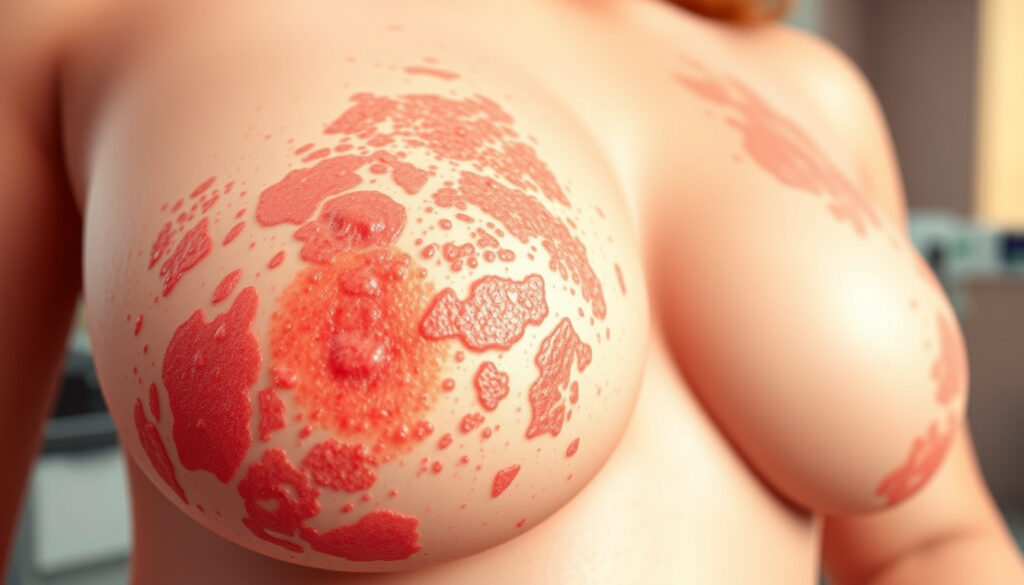
Picture of Inflammatory Brea t Cancer in Early Stage – What to Look For
A persistent rash, a patch of warmth, a breast that suddenly looks larger than the other. For many women, these are the first signs of inflammatory breast cancer (IBC), a rare and aggressive form of the disease that does not typically present as a lump. Understanding what early-stage IBC looks like in pictures can be the key to catching it sooner, when treatment is most effective.
IBC accounts for 1 to 5 percent of all breast cancers, yet it is responsible for a disproportionate number of late-stage diagnoses. Because it infiltrates the skin and clogs lymph vessels rather than forming a distinct mass, it is often mistaken for an infection, an allergic reaction, or even an insect bite. According to the National Breast Cancer Foundation, the earliest visible changes are usually redness, swelling, warmth, skin thickening, and the classic orange-peel texture known as peau d’orange.
The urgency is real. IBC progresses rapidly — often within weeks — and is commonly diagnosed at stage 3. Several sources, including the Breast Cancer Research Foundation, note that it is reported more often in Black women and women under 40. Because a discrete lump is usually absent, visual identification becomes the first and most critical step in the diagnostic journey.
What Are the First Symptoms of Inflammatory Breast Cancer?
Rapid (weeks to months)
Rash / redness / peau d’orange
Clinical + biopsy + imaging
See doctor immediately if suspected
The first symptoms of IBC are often subtle and easy to dismiss. Early-stage visual signs include faint or patchy redness, pink, red, or purple discoloration, and skin that looks bruised. Many women notice a rapid enlargement of one breast, a feeling of warmth or heaviness, and subtle dimpling or puckering that resembles the texture of an orange peel. These details are documented across multiple medical sources, including Cleveland Clinic and the National Cancer Institute.
- IBC is often misdiagnosed as mastitis, delaying treatment by weeks.
- Survivors report that the rash often began as a subtle warmth, heaviness, or itching.
- Peau d’orange (orange-peel skin) is a hallmark sign but may not appear at the very earliest stage.
- IBC does not always present with a distinct lump; it is a diffuse infiltration of the skin.
- Black women are more likely to be diagnosed at later stages, partly due to a lack of diverse imagery.
- Nipple flattening or inversion, breast tenderness, and swollen lymph nodes under the arm are common.
- The rash may appear suddenly, even overnight, and can mimic a bruise or irritation.
| Metric | Value |
|---|---|
| Incidence | 1-5% of all breast cancers |
| Age range | Typically under 55 years old |
| ER/PR status | Often hormone receptor negative |
| 5-year survival | Approximately 40% (lower with late detection) |
| Common misdiagnosis | Mastitis, cellulitis, allergic rash |
| Primary detection method | Clinical exam, imaging, and skin biopsy |
| Typical stage at diagnosis | Stage 3 |
How to Identify Inflammatory Breast Cancer Rash in Early Stages (With Pictures)
Visual guides and survivor descriptions emphasize that IBC photos usually show subtle to moderate skin changes, not dramatic open sores or a visible tumor. The most reliable images, such as those collected by The IBC Network Foundation, illustrate localized redness or widespread discoloration covering part or most of one breast. A common pattern is dimpling, rippling, or thickened skin with an orange-peel texture. The affected breast often appears larger and more swollen than the other side, and bruise-like patches are frequently observed.
What Does Peau d’Orange Look Like in Early Stage IBC?
Peau d’orange occurs when lymphatic blockage causes fluid buildup and skin thickening. The skin takes on a pitted, dimpled appearance that closely resembles the surface of an orange. As noted by Free Medical Journals, this sign may not be present at the very earliest stage, but it becomes more prominent as the cancer progresses. It is often most visible when the arm is lifted or when the breast is examined from the side.
What Are the Visual Signs of IBC Besides Redness?
Beyond redness, women should look for breast tenderness, itching, a burning sensation, and a feeling of firmness or heaviness. Nipple changes are also significant: the nipple may flatten, become inverted, or develop a crust. Swollen lymph nodes under the arm or near the collarbone can accompany these skin changes. Survivor accounts collected by MD Anderson Cancer Center describe a recurring pattern of swelling, peau d’orange, rash or skin color change, and inconsistent pain or lumps.
Unlike a typical breast cancer that forms a lump, IBC spreads like a sheet across the breast tissue. The skin changes are often the first and only outward sign. A mammogram may miss IBC because there is no distinct mass to detect.
Inflammatory Breast Cancer in Black Women: Why Visual Guides Must Be Inclusive
Several sources, including the National Breast Cancer Foundation, note that IBC is more common in Black women than in some other groups. Despite this higher incidence, most online photo references show only lighter skin tones. For darker skin, the discoloration of IBC may look purple, bruised, or darker rather than bright red, as explained by HealthCentral. This visual difference can make early recognition significantly harder and may contribute to later-stage diagnoses in minority populations.
Clinicians and patient advocates argue that the lack of diverse imagery in medical education and public health materials creates a dangerous gap. Without representative pictures, both patients and doctors may miss the early warning signs on darker skin. The push for inclusive visual guides is not just about representation — it is about saving lives through equitable access to early detection.
On darker skin, IBC changes can look like a bruise, a deep purplish patch, or an area of skin that appears darker than the surrounding tissue. The classic bright red hue may be entirely absent. If you notice any persistent change in skin color or texture on one breast, seek medical evaluation even if there is no redness.
How to Tell the Difference Between IBC Rash and Other Skin Conditions
IBC and mastitis (a breast infection) can look remarkably similar. Both may cause redness, warmth, swelling, pain, and a rash-like appearance. The key distinction, according to Cleveland Clinic, is that mastitis is an infection that typically improves with antibiotics or other appropriate treatment. IBC, by contrast, persists and progresses quickly and does not resolve in the usual way. If a rash or skin change lasts more than one to two weeks, spreads or worsens quickly, or causes one breast to enlarge, a prompt medical evaluation is essential.
Other conditions that can be confused with IBC include allergic reactions, eczema, and cellulitis. However, IBC has several telltale features: it involves a large portion of the breast, it often has no palpable lump, and it produces skin thickening and dimpling that do not improve with standard treatments for infection or inflammation. The Macmillan Cancer Support guide emphasizes that any persistent breast change, even without a lump, warrants a clinical breast exam and, if needed, a referral to a breast specialist.
How Fast Does Inflammatory Breast Cancer Progress?
IBC is one of the fastest-progressing forms of breast cancer. The timeline from first noticeable symptom to diagnosis is often measured in weeks, not months. Below is a typical progression pattern based on clinical reports.
- Week 1–2: Subtle warmth, itching, or heaviness. A faint rash may come and go.
- Week 3–4: Persistent redness, swelling, and peau d’orange texture become visible.
- Month 2: Nipple retraction, more pronounced skin thickening, and visible breast asymmetry appear.
- Diagnosis: Clinical exam, ultrasound, mammogram, and skin biopsy confirm IBC.
Because IBC invades the skin and blocks lymph vessels rather than forming a discrete mass, it is commonly diagnosed at stage 3. Mammograms can detect skin thickening and subtle architectural distortion, but they are not always definitive. Ultrasound and a punch biopsy of the affected skin — looking for cancer cells in the dermal lymphatics — are often required for a confirmed diagnosis.
What We Know vs What Is Still Unclear About IBC
| Established Information | Information That Remains Unclear |
|---|---|
| IBC is a clinically distinct, aggressive form of breast cancer. | Why some patients develop rash-like symptoms and others do not. |
| Early detection dramatically improves prognosis. | Optimal screening protocols for IBC (mammogram often misses it). |
| Peau d’orange is a classic sign but not always present initially. | Whether over-the-counter antihistamines or creams can mask early IBC. |
| Biopsy of the skin confirms diagnosis. | Why IBC is more common in Black women and women under 40. |
If you have persistent breast changes — even without a lump — seek a clinical breast exam and, if needed, a referral to a breast specialist.
Why Visual Recognition of IBC Matters
IBC is frequently missed because its appearance mimics benign conditions like mastitis, eczema, or allergic reactions. Most online photo references lack diversity in skin tones, contributing to diagnostic delays in minority populations. Real patient photos combined with medical illustrations and survivor anecdotes offer the most effective educational approach. Search engines and AI overviews increasingly prioritize content that answers specific visual comparison questions, making well-sourced visual guides critical for public health.
Survivor Stories and Source Perspectives
“I thought it was an allergic reaction to laundry detergent. I had no idea it was cancer.”
— IBC survivor testimonial, MD Anderson Cancer Center (2024)
“My nipple looked different. It was flattened, almost inverted. No lump, just this weird change.”
— Patient narrative, The IBC Network Foundation
“The skin on my breast looked like an orange peel when I lifted my arm.”
— IBC survivor, HealthCentral (2025)
What to Do If You Suspect IBC — A Concise Summary
If you notice any of the visual signs described above — a persistent rash, peau d’orange texture, swelling, or nipple changes — schedule a clinical breast exam within one week. Ask for both an ultrasound and a mammogram, even if no lump is felt. If imaging is inconclusive, request a skin biopsy. Do not wait for a rash to clear up on its own; IBC does not resolve without treatment. For more visual comparison guides, see What Does Herpes Look Like – Visual Guide to Stages and Symptoms and Fungal Infection on Skin – Causes, Symptoms, Treatments.
Frequently Asked Questions
Can inflammatory breast cancer start with itching only?
Yes. Many survivors report persistent itching or tingling as an early symptom, even before visible redness appears.
Does IBC show up on a mammogram?
Mammogram can detect skin thickening and subtle architectural distortion, but it is not always definitive. Ultrasound and biopsy are often needed.
Is IBC genetic?
IBC is not strongly linked to BRCA mutations like other breast cancers, but genetic testing is still recommended for newly diagnosed patients.
Can I have IBC without a rash?
Rarely, but possible. Some patients present with swelling, pain, or breast asymmetry without overt redness.
How long can you have IBC without knowing?
IBC progresses quickly — most patients are diagnosed within 1 to 3 months of symptom onset.
What should I do if a breast rash does not go away after antibiotics?
If a rash or skin change does not improve with antibiotics within 1 to 2 weeks, request a breast specialist referral and a skin biopsy.
Is IBC painful?
Yes. Many women describe a persistent pain, tenderness, or a burning sensation in the affected breast as an early symptom.
Can men get inflammatory breast cancer?
It is extremely rare, but IBC has been reported in men. The symptoms and visual signs are the same.
More related posts
 East Links Family Park – Guide to Attractions, Prices and Tips
 Find My Samsung Phone – SmartThings Find Guide
 Lee Min-Ho – Biography, Age, Dramas, and Latest News
 When Do You Ovulate – Timing, Signs and How to Track
 4 Month Sleep Regression – Duration, Signs and Solutions
 Microsoft Flight Simulator 2024 – Release Date, PS5, and Career Mode
 Oral-B Pro 1 – Review, Price and Models Compared for 2025
 Jonathan Ross – Biography, Career, Net Worth and The Jonathan Ross Show