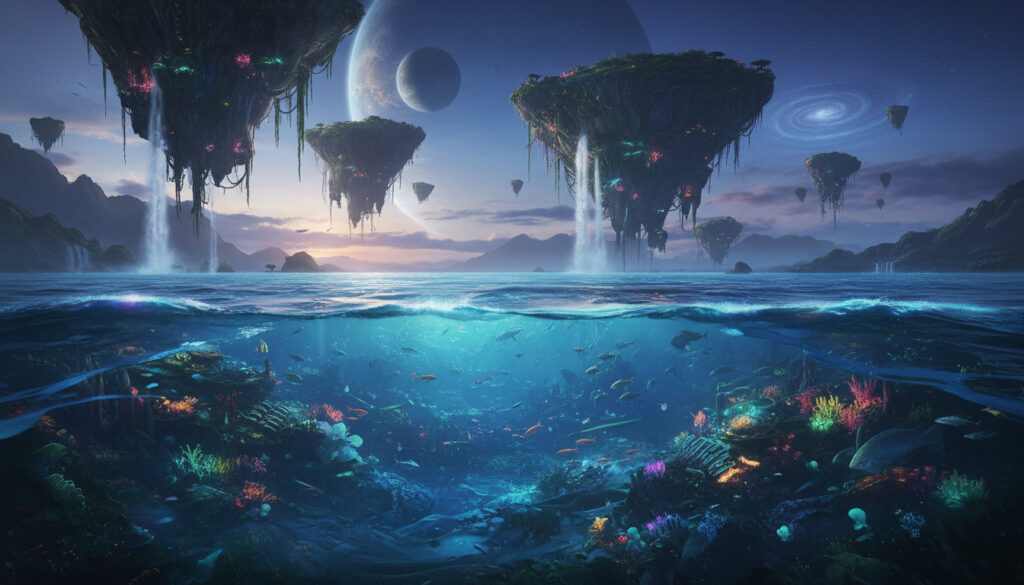
Avatar The Way of Water – Detailed Review and Analysis
Avatar: The Way of Water — A Technical Triumph Returns to Pandora
James Cameron’s return to the lush alien moon of Pandora arrived thirteen years after the original Avatar rewrote box office history. Avatar: The Way of Water plunges audiences into the oceanic realms of the Metkayina clan, expanding the visual language of digital cinema while maintaining the environmental allegories that defined the 2009 blockbuster. The film represents not merely a sequel but a wholesale reinvention of underwater performance capture technology, setting new benchmarks for what virtual production can achieve.
At a Glance
Release Date: December 16, 2022
Director: James Cameron
Production Budget: $350–400 million
Global Box Office: $2.32 billion
Runtime: 192 minutes
Distribution: 20th Century Studios
Visual Innovation Beneath the Surface
The production demanded breakthroughs in underwater filming techniques previously considered impossible for performance capture. Cameron’s team developed specialized waterproof cameras and lighting rigs to capture actors swimming at depths, recording reference footage that Weta Digital and Industrial Light & Magic transformed into the bioluminescent seascapes of Pandora. Unlike traditional dry-for-wet techniques, performers actually submerged themselves in massive water tanks, with Cameron insisting on practical submersion to achieve authentic buoyancy and light refraction on skin.
The results manifest in the film’s extended aquatic sequences, where the rules of terrestrial physics no longer apply. Characters move with genuine hydrodynamic drag, their CGI counterparts responding to water currents and caustic lighting patterns that required unprecedented rendering power. Visual effects supervisors noted that single frames of underwater footage required up to 200 hours of computation time, pushing the boundaries of cloud-based rendering infrastructure.
| Metric | Avatar (2009) | Avatar: The Way of Water (2022) |
|---|---|---|
| Production Budget | $237 million | $350–400 million |
| VFX Companies | 4 primary vendors | 9+ vendors (Weta, ILM, Framestore) |
| Water Tank Capacity | N/A (dry-for-wet) | 900,000 gallons |
| Frame Render Time (avg) | 47 hours | 200+ hours (underwater scenes) |
Production Architecture
Principal photography occurred across multiple stages in Manhattan Beach, California, where the production constructed a 900,000-gallon tank specifically for underwater capture. Actors underwent extensive free-diving training to hold their breath for extended takes, with Sigourney Weaver reportedly achieving static apnea times exceeding six minutes. This commitment to practical immersion distinguishes the sequel from its predecessor and from contemporary blockbusters relying heavily on digital water simulation.
The narrative shifts focus from the forest-dwelling Omatikaya to the reef-dwelling Metkayina, introducing new ecosystems and creature designs developed through marine biology consultation. Production designers studied coral reef systems and deep-ocean bioluminescence to create the archipelago environments, ensuring that Pandora’s oceans maintained internal biological consistency while providing visually distinct color palettes from the first film’s jungle setting.
Development Chronology
The path to theaters encountered multiple delays as Cameron waited for technology to catch up with his aquatic ambitions. Originally announced for 2014, the film’s release slipped repeatedly while the director developed simultaneous scripts for multiple sequels and refined the underwater performance capture pipeline.
- 2010: Cameron confirms underwater setting for sequel
- 2013: Writing process begins for four simultaneous sequels
- 2017: Production officially begins in California
- 2018: Principal photography wraps
- 2020–2022: Extensive post-production and rendering
- December 2022: Theatrical release
Clarifying the Technology
Misconceptions persist regarding the film’s use of high frame rate presentation. Rather than committing fully to 48 frames per second throughout, Cameron employed variable frame rate technology, switching between 24fps for dramatic dialogue scenes and 48fps for action sequences. This selective application attempts to minimize the soap opera effect while maximizing clarity in fast-moving underwater shots where motion blur becomes problematic.
Similarly, the film does not constitute a complete switch to virtual production techniques popularized by The Mandalorian. While LED volumes appear in certain sequences, Cameron relied primarily on traditional greenscreen environments combined with physical water tanks, maintaining that real water interaction provided irreplaceable reference for both actors and digital artists.
Commercial and Critical Reception
Despite concerns about audience retention thirteen years after the original, The Way of Water secured the third-highest global opening of 2022 and ultimately surpassed $2.3 billion worldwide. Box office analysts noted particularly strong legs through January 2023, suggesting positive word-of-mouth countered initial skepticism about the three-hour-plus runtime.
Critical consensus centered on the film’s technical achievements while noting narrative familiarity. The environmental themes regarding ocean conservation and whaling operations resonated with reviewers, though some criticized the screenplay’s reliance on familiar family-in-peril structures. Cameron’s directorial approach remains divisive among critics who view his work as spectacular but thematically heavy-handed.
We are not just making a movie, we are building a world. The ocean gives us infinite biodiversity to explore. Every creature, every plant has to feel like it evolved naturally within this ecosystem.
Synthesis
Avatar: The Way of Water succeeds primarily as a demonstration of cinematic possibility, proving that underwater environments need not remain the province of documentary filmmaking or limited sequences within action films. By solving the technical challenges of wet-for-wet performance capture, Cameron’s team has created a template for future productions seeking to integrate human performance with aquatic environments.
The film’s financial success suggests that theatrical exhibition retains viability for spectacle-driven cinema capable of offering experiences unavailable through streaming platforms. With three additional sequels currently in various production stages, the franchise appears positioned to dominate December release slots through the decade. The implications for exhibition technology remain significant, as theaters worldwide upgraded projection and sound systems specifically to meet Cameron’s technical specifications.
Frequently Asked Questions
How long is Avatar: The Way of Water?
The film runs 192 minutes (3 hours and 12 minutes), including credits. Cameron has defended the length by noting that audience retention remained strong throughout the theatrical run.
Do I need to watch the first Avatar to understand this film?
While the sequel provides some contextual exposition, familiarity with the original enhances understanding of character relationships and the RDA’s corporate motivations. The narrative functions as a standalone family drama but rewards knowledge of the original’s world-building.
Was the film shot underwater?
Yes, unlike the first film which used dry-for-wet techniques, actors performed in a 900,000-gallon water tank using specialized performance capture equipment designed to function while submerged.
What is the budget compared to other films?
With production costs estimated between $350–400 million, it ranks among the most expensive films ever produced, though precise figures remain confidential to 20th Century Studios.
More related posts
 Oliver Hudson Movies and TV Shows – Full Filmography & Bio
 What Time Is Love Island On Tonight – UK ITV2 Schedule & All Stars Times
 P&O Cruises Cancels Arvia Cruise – 2026 Med Cancellation and Alternatives
 H&M UK – Complete Online Shopping Guide for 2025
 Matthew Modine – Biography, Movies, Wife, Net Worth
 Blackout Curtains for Bedroom – Best UK Brands, Types and Buying Guide
 Le Cordon Bleu London – Practical Guide to Courses and Fees
 X-Men Days of Future Past – The Time Travel Reboot Explained